

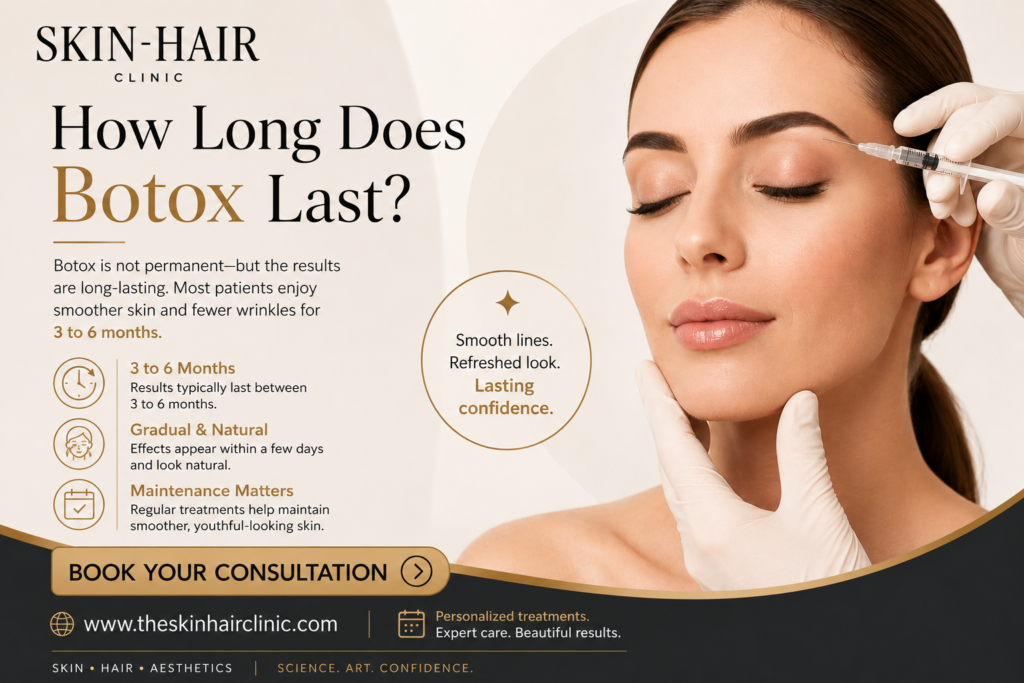
If you’ve ever left an injector’s chair wondering exactly how long does Botox last, it’s one of the most searched questions in aesthetic medicine, and for good reason.
The answer isn’t a single number; it depends on where you’re treated, how your muscles respond, and how your body metabolizes the product.
At Skin-Hair Clinic in Medellín, Colombia, Dr. Lina Maria Muñoz and her team have spent years helping local and international patients understand exactly what to expect from botulinum toxin treatments, not just the textbook results, but the real, area-by-area timeline.
This guide breaks down how long does Botox last for different treatment zones, what makes results fade faster for some people, and how to get the most out of every session.
What is Botox? Understanding Botulinum Toxin
Botox is a well-known brand of botulinum toxin, a neurotoxin that temporarily reduces the activity of targeted muscles. When injected in carefully selected areas, it blocks nerve signals that tell those muscles to contract. Less repetitive muscle movement can soften dynamic lines and wrinkles.
In simple terms, Botox does not erase your skin or permanently remove wrinkles. Instead, it temporarily reduces the muscle activity contributing to certain expression lines.
How long does Botox take to work?
One common misconception is that Botox produces an instant result. It does not.
If you are wondering how long does Botox take to work, expect the process to develop gradually:
- First few days: Subtle or no visible change may be noticeable.
- Around days 3–5: Muscle activity may begin to decrease.
- Around days 7–10: The cosmetic effect becomes more apparent.
- By 10–14 days: The final result is generally easier to assess.
This is why it is usually better to assess your Botox result after approximately two weeks rather than judging it immediately after your appointment.
Also Read – What Is Hair Botox Treatment and Why Is Everyone Talking About It?
How long does Botox last? The real timeline by area
Treatment area | How long does Botox last? | What to expect |
Forehead lines | 3 to 4 months | Movement gradually returns as the effects begin to wear off. |
Crow’s feet | 3 to 4 months | Results may fade slightly sooner because these muscles are constantly active when blinking and smiling. |
Masseter Botox | 4 to 6 months | How long does masseter Botox last can vary because the masseter is a larger, denser muscle. It may also take longer to show its full effect. |
Neck bands and smaller treatment areas | 2 to 3 months | These areas may see the effects wear off somewhat sooner. |
When patients ask Botox how long does it last, there is no single timeline that applies to everyone. The treatment area, muscle strength, dosage, and individual response all influence how long will Botox last. A personalised assessment can help determine what you are likely to experience.
When does Botox start to wear off?
A common concern is when does Botox start to wear off?
The answer is gradual rather than sudden. As nerve signaling progressively returns, the treated muscle begins regaining movement. You may notice:
- More movement when making facial expressions
- Fine lines are becoming gradually more visible
- Increasing muscle activity in the treated area
- A slow return toward your pre-treatment appearance
So, does Botox wear off? Yes. Its effect is temporary by design. The gradual return of muscle activity is a normal part of the Botox timeline.
This explains how long Botox lasts better than thinking of treatment as something that simply “expires.”
Why does my Botox wear off so fast? 5 real reasons
This is one of the most common and most frustrating questions we hear. If you’re asking why does my Botox wear off so fast, here are the usual culprits:
- A fast metabolism or high activity level – athletes and highly active patients often metabolize the toxin more quickly.
- Under-dosing – too few units for the muscle size or strength won’t hold as long.
- It’s your first treatment – first-time results are often shorter and tend to last longer with consistent, repeat sessions.
- Inconsistent treatment intervals – waiting too long between sessions can mean starting the muscle “training” effect over each time.
- Lifestyle factors – sun exposure, high stress, and inflammation can all play a role in how quickly effects diminish.
Quick fact: Repeat Botox patients often report their results lasting progressively longer over time, since the treated muscle gradually “learns” to relax with less resistance.
How to make your Botox last longer?

While no treatment lasts forever, a few daily habits can extend your results.
- Stick to a consistent follow-up schedule instead of waiting until lines fully return.
- Protect your skin from excessive sun exposure.
- Work with an experienced team like Skin And Hair Clinic, where they tailor the dose to your muscle strength, not a standard formula.
- Avoid vigorous facial massage or excessive rubbing of the treated area in the first 24–48 hours.
How long is a Botox appointment?
Botox is generally a quick outpatient procedure. A fine needle is used to place small amounts of product into selected muscles, sometimes at several injection points. Discomfort is usually mild, and patients can generally return home afterward.
The total appointment time can vary depending on:
- Number of areas being treated
- Consultation and facial assessment
- Number of injections required
- Whether other treatments are performed during the same visit
The injection itself may be brief, but the assessment should never be rushed.
Botox side effects: What should you expect?
Like any injectable treatment, Botox side effects are generally mild and temporary when performed by a trained specialist. These can include:
- Slight bruising or redness at the injection site
- Temporary swelling
- Mild headache in the first day or two
- Rarely, slight asymmetry if the dose isn’t calibrated correctly
Choosing a certified, experienced provider significantly reduces these risks, which is exactly why the injector’s skill matters just as much as the product itself.
How can you get more predictable Botox results at Skin And Hair clinic?
Getting Botox is not simply about deciding where to inject and how much product to use. Predictable, natural-looking results start with understanding your facial anatomy, muscle movement, skin quality, and what you want to achieve. That is where an experienced, personalized approach can make a meaningful difference.
At Skin And Hair Clinic, Botox treatment is approached as part of comprehensive aesthetic and dermatological care rather than a one-size-fits-all procedure. The clinic’s focus on personalized treatment plans, advanced dermatology, medical expertise, and natural-looking outcomes helps ensure that treatment is tailored to your individual facial features and aesthetic goals.


How Long Does Botox Last? A Complete Guide to Botox Results
How Long Does Botox Last? A Complete Guide to Botox

Colombia vs Turkey Hair Transplant: Which Country Offers Better Results in 2026?
Colombia vs Turkey Hair Transplant: Which Country Offers Better Results

Hair Transplant Cost Colombia: Complete 2026 Pricing Guide
Hair Transplant Cost Colombia: Complete 2026 Pricing Guide Hair loss
Quick Enquiry
Your next step: Long-lasting, natural results start with the right clinic
At the end of the day, how long does Botox last comes down to more than the product; it comes down to precision, experience, and a treatment plan built around your muscles, not a generic average.
At Skin And Hair Clinic, Dr. Lina Maria Muñoz combines medical expertise with an artist’s eye to help you get results that don’t just look natural, they last.
Ready to find out how long your Botox could really last? Book your personalized consultation with Skin And Hair Clinic today.
FAQ's on how long does botox last
Botox typically lasts around three to four months, although some patients may experience shorter or longer-lasting results depending on individual factors.
The duration varies by treatment area, muscle activity, dosage, anatomy, and individual response. Most results last several months.
Forehead Botox commonly lasts several months, although the exact duration depends on muscle activity, treatment planning, and individual response.
Masseter Botox can last several months, but duration varies according to muscle strength, dosage, anatomy, and the reason for treatment.
Botox usually wears off gradually after its peak effect, with muscle movement progressively returning as nerve signaling resumes.
Yes. Botox is temporary, and muscle activity gradually returns. Repeat treatment may be considered when appropriate for maintaining the desired effect.
Initial effects may appear within a few days, while the full cosmetic result is generally clearer within about 10 to 14 days.
Individual biology, muscle strength, treatment area, dosage, and previous treatment history can all influence how quickly Botox results fade.