

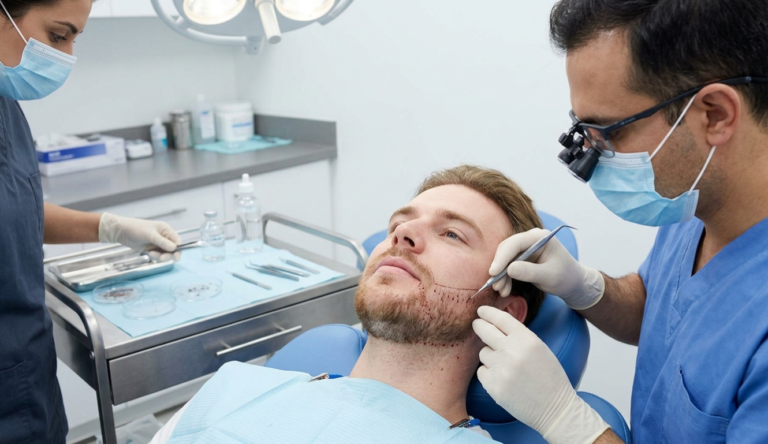
A well-defined beard has become an important part of male grooming and personal style. For some men, however, growing a dense and evenly distributed beard can be difficult due to genetics, hormonal factors, or scarring. One of the most effective options available today is a facial hair transplant.
At Skin-Hair Clinic, patients frequently seek professional guidance for improving beard density and restoring facial hair in areas where growth is limited. In a facial hair transplant, healthy hair follicles are taken back of the scalp, and carefully implanted into the beard region.
This guide explains everything patients should know about beard hair transplant procedures, including causes of patchy beard growth, the surgical process, recovery expectations, potential risks, and realistic outcomes.
Understanding the common causes of patchy beard growth
Facial hair growth is primarily controlled by genetics and hormones, particularly testosterone and its derivative dihydrotestosterone (DHT). However, several other factors may prevent the beard from growing fully.
Common causes include:
- Genetic predisposition to sparse facial hair
- Hormonal imbalances
- Scarring from burns, surgery, or injuries
- Skin conditions such as alopecia areata
- Over-plucking or follicle damage
- Age-related hair thinning
Dermatology research indicates that hair loss conditions affect over 50 million men globally, and in some individuals, this can also influence beard growth patterns.
When natural beard follicles are inactive or absent, beard hair transplant procedures can help introduce new hair follicles into those areas.
What is a facial hair transplant?
A facial transplantation is a surgical procedure that restores or enhances facial hair by transplanting hair follicles into the beard, moustache, or sideburn areas.
The transplanted follicles typically come from the scalp because they are genetically strong and resistant to hair loss. After healing, the transplanted hair grows permanently and blends naturally with existing facial hair.
Common reasons patients choose a beard transplant include:
- Filling patchy beard areas
- Creating a thicker or fuller beard
- Restoring hair growth in scarred skin
- Designing moustache or goatee shapes
- Correcting uneven facial hair distribution
Modern facial hair implants are carefully placed to mimic the natural direction and pattern of hair growth.
How are beard transplant procedures performed?
A beard transplant is usually performed using a minimally invasive technique called Follicular Unit Extraction (FUE). The procedure is typically done under local anaesthesia.
Procedure step | Explanation |
Consultation and beard design | The surgeon evaluates facial features and designs the beard pattern. |
Donor hair extraction | Individual follicles are carefully removed from the scalp. |
Graft preparation | Extracted follicles are examined and prepared for implantation. |
Recipient site creation | Small incisions are created in the beard area following natural hair angles. |
Follicle implantation | Hair grafts are placed precisely to achieve natural density. |
Depending on the desired beard density, beard growth surgery may involve 1,500 to 3,000 grafts.
Do beard transplants work effectively?
Many patients researching the procedure ask, Do beard transplants work and whether results look natural.
When performed by experienced and trained surgeons, the procedure has a high success rate. Studies in hair restoration show that graft survival rates can reach 90-95%, meaning most transplanted follicles continue growing permanently.
Patients often review beard transplant before and after results to understand the level of improvement possible. These images typically show significant enhancement in beard density and shape after the healing process is complete.
Also Read – Platelet Rich Plasma (PRP) for Hair Loss
Beard transplant recovery time and healing process
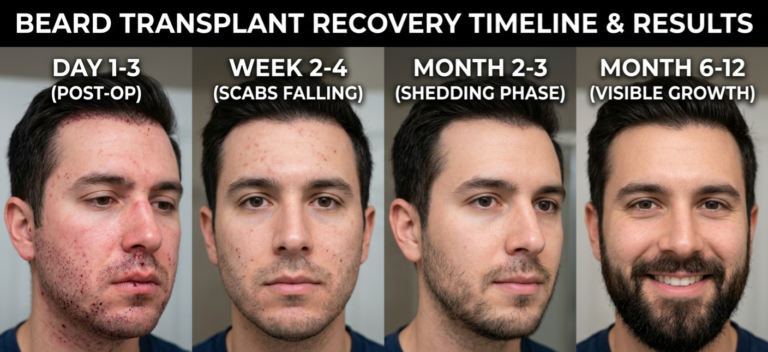
Recovery after a facial hair transplant is generally mild and manageable.
Most individuals can return to routine activities within a few days, although careful aftercare is necessary.
Typical beard transplant recovery time follows this pattern:
- First few days: Mild redness, swelling, and small scabs around graft sites
- 1-2 weeks: Scabs fall off, and skin continues healing
- 3-4 weeks: Transplanted hairs may shed temporarily
- 3-4 months: New beard hair begins to grow
- 6-12 months: Final beard thickness and density become visible
Temporary shedding during the first month is normal and part of the natural hair growth cycle.
Understanding beard transplant cost and influencing factors
Another common question patients ask is about how much is facial hair transplant treatment costs.
The beard transplant cost varies depending on several important factors:
- Number of grafts required
- Surgical technique used
- Surgeon expertise
- Clinic location
- Complexity of beard design
Some clinics may refer to the procedure using terms such as beard implants cost or beard hair transplant cost, but these generally refer to the same type of treatment.
When searching online for a beard transplant near me, it is important to prioritise medical expertise and safety rather than focusing only on price.
Can beard hair be used for hair transplant procedures?
Patients sometimes ask whether beard hair can be used for hair transplant procedures on the scalp.
In certain cases, the answer is yes. Beard hair may serve as an additional donor source for scalp hair restoration, especially when the scalp donor supply is limited. However, because beard hair is thicker and has a different growth pattern, surgeons use it selectively to maintain a natural appearance.
Risks and benefits of beard transplant procedures
A beard transplant is generally considered safe when performed in a professional clinical setting, but like any surgical procedure, it carries some potential risks.
Possible side effects include:
- Temporary redness or swelling
- Minor infection risk
- Small donor-area scars
- Uneven growth if grafts are poorly placed
- Ingrown hairs during early regrowth
The benefits of beard transplants often include permanent facial hair growth, improved beard density, and enhanced facial aesthetics.
Practical advice for patients considering beard implants
Patients interested in beard implants or facial hair implants should understand what the procedure can realistically achieve before moving forward.
Helpful guidance includes:
- Choose experienced hair restoration specialists
- Review the genuine beard transplant before and after results
- Understand that results develop gradually over months
- Follow post-procedure care instructions carefully
- Maintain realistic expectations about density and shape

The ultimate guide to getting a beard transplant
The ultimate guide to getting a beard or facial hair
How Often Should You Do Red Light Therapy?
How often should you do red light therapy? Interest in
What Makes Advanced Hair Restoration Different from Traditional Methods?
What Makes Advanced Hair Restoration Different from Traditional Methods? Hair
Quick Enquiry
A clearer path to fuller facial hair
A facial hair transplant offers a medically proven solution for men who struggle with patchy or uneven beard growth. By transplanting healthy follicles into targeted areas, the procedure can create natural and long-lasting beard density.
With modern surgical techniques, careful beard design, and proper recovery care, many patients achieve significant improvement in facial hair appearance through beard hair transplant procedures.
If you are considering a beard transplant and want personalised advice, the specialists at Skin-Hair Clinic can evaluate your beard growth pattern and guide you toward the most appropriate treatment option.
Schedule a consultation to know more.
FAQ's On Facial Hair Transplant
A facial hair transplant is a procedure that relocates hair follicles from the scalp to the beard or moustache area to improve facial hair growth.
Yes, when performed correctly, the transplanted hair follows the natural direction and growth pattern of beard hair.
Initial healing takes around one to two weeks, while full beard growth may take up to 12 months.
The procedure is done under local anaesthesia, so patients usually feel minimal discomfort.
Costs vary depending on the number of grafts, the clinic, and the complexity of the beard design.
Yes. Once the transplanted follicles establish a blood supply, they continue growing permanently.
Yes, beard hair may sometimes be used as an additional donor source for scalp hair restoration.
Patients are typically advised to wait about two to three weeks before shaving the treated area.
When performed by trained specialists, beard transplant procedures are generally safe and effective.
Depending on the desired beard density, between 1,500 and 3,000 grafts may be required.