

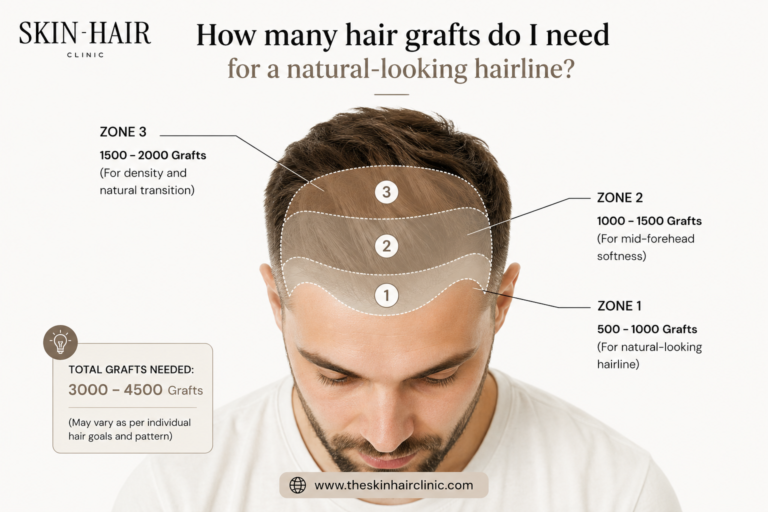
Many people are worried about balding at the crown area or all over the top and look for restorative procedures. During an initial consultation, one of the first questions patients have is “How many hair grafts do I need to get an optimal result?” Getting a natural result depends on the density, angle and distribution of your hair on the frontal frame of your face.
At Skin & Hair Clinic, we understand that determining how many grafts do i need for hair transplant surgery is not a matter of guessing. Instead, it requires a precise clinical evaluation of your current hair loss pattern, the quality of your donor area, and your personal long-term aesthetic goals. Understanding how these factors interact allows you to plan your procedure with confidence.
Understanding hair transplant grafts and follicular units
To accurately estimate your needs and determine how many hair grafts do I need, it helps to understand what a hair graft looks like under a microscope. Many people think that it is a single strand of hair when it comes to each graft, but it’s not. In fact, hair grows in small clumps referred to as hair follicles.
When looking at the biological math of a procedure, 1 graft = how many hair strands can vary from person to person. The number of individual hairs in a single follicular unit ranges from 1 to 4.
Therefore, when evaluating how many hairs in a graft are available, the industry standard relies on an average of two hairs per graft. This distinction is critical because hair transplant number of grafts determines the coverage area, while the individual hair count dictates the ultimate density.
How the Norwood scale determines your hair loss stage?
To evaluate how many hair grafts do i need, hair restoration surgeons utilize a standardized classification system known as the Norwood scale. This metric categorizes male pattern baldness into distinct stages, ranging from minor recession to advanced hair loss across the entire scalp.
Stage 1: Minor recession around the temples, often requiring a 500 grafts hair transplant cost evaluation for small touch-ups or a subtle 600 grafts hair transplant to fill the corners.
Stage 2: Deeper recession at the temples and initial thinning at the crown, typically requiring a baseline hair transplant how many grafts assessment to re-establish the frontal border.
Stage 3: Significant recession at the front combined with a distinct bald spot at the vertex.
Stages 4 to 6: Advanced hair loss where the front hairline and crown meet, requiring a large number of hair transplant grafts for noticeable coverage.
Calculating how many hair grafts do i need for transplant placement?
When calculating how many hair grafts do I need, hair transplant density requires an analysis of the specific zones requiring coverage. The frontal hairline demands meticulous placement using single-hair grafts to avoid a harsh, artificial look. As the surgeon moves backward into the mid-scalp and crown, multi-hair grafts are used to build volume.
For moderate thinning, patients often ask how much area does 2000 grafts cover across the scalp. Generally, 2000 grafts can comfortably cover the frontal third of a moderately receding scalp with good density. If the thinning extends further back, a hair transplant 3000 grafts session might be necessary to address both the hairline and the mid-scalp during a single clinical appointment.
Also Read – How Long Do Hair Transplants Last?
The structural reality of a 3000 grafts hair transplant
Undergoing a 3000 hair grafts procedure represents a comprehensive session often recommended for individuals sitting at Stage 4 or 5 on the hair loss scale. When reviewing 3000 hair grafts before and after case studies, the most successful outcomes are those where the donor zone on the back and sides of the head is thick enough to supply this volume without looking over-harvested.
The average grafts for hair transplant sessions typically range from 1500 to 3500 grafts. Requesting more than this in a single day requires careful planning, as there is a biological limit to how many hair transplants can you have in a lifetime. Most individuals have a total lifetime donor reserve of around 6000 to 8000 grafts, making resource management a top priority for your surgeon.
Evaluating how many fue grafts I need and the cost factors?
The specific technique used also influences your planning. Follicular unit extraction (FUE) involves harvesting individual units one by one, leaving minimal, dot-like scars. When wondering how many fue grafts do i need, the answer aligns closely with standard graft calculations, but the health of your scalp skin plays a larger role in graft survival rates.
Financial planning is often tied directly to these volumes. While a minor 1000 grafts hair transplant cost might be lower due to the shorter surgery time, a larger session involves extensive labor. Patients should focus on the 1 graft of hair cost as a metric of quality, ensuring they choose a qualified clinic that prioritizes graft survival over cheap, bulk pricing.
The hair transplant timeline and what to expect?
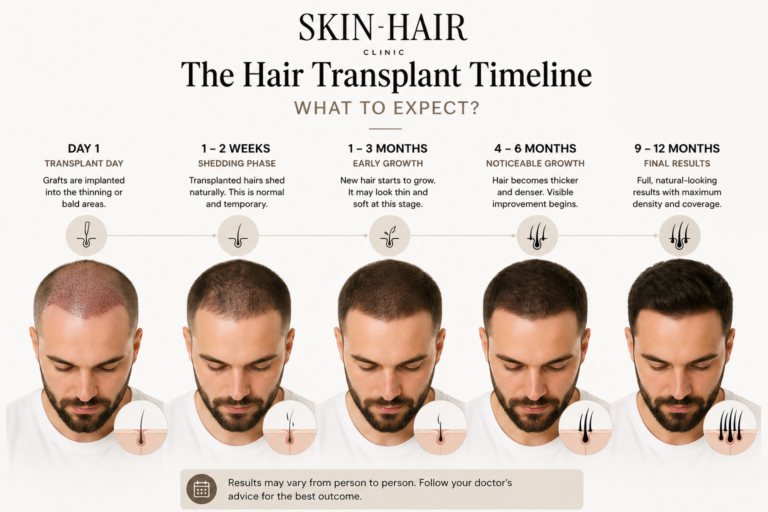
Once you establish how many grafts are needed for hair transplant success, understanding the recovery sequence helps manage expectations. The hair transplant timeline requires patience, as the hair must shed before growing permanently.
Weeks 1 to 3: The newly placed grafts secure themselves in the scalp, and minor crusting clears up.
Months 1 to 2: The transplanted hair strands enter a resting phase and shed, which is a normal part of the physiological cycle.
The 3 month hair transplant milestone: At this stage of the month by month journey, early signs of fine, new hair growth begin to breach the surface of the skin.
Months 6 to 12: The hair thickens consistently, with final density and texture achieved around the one-year mark.


How Long Does Botox Last? A Complete Guide to Botox Results
How Long Does Botox Last? A Complete Guide to Botox

Colombia vs Turkey Hair Transplant: Which Country Offers Better Results in 2026?
Colombia vs Turkey Hair Transplant: Which Country Offers Better Results

Hair Transplant Cost Colombia: Complete 2026 Pricing Guide
Hair Transplant Cost Colombia: Complete 2026 Pricing Guide Hair loss
Quick Enquiry
Plan your consultation at Skin & Hair Clinic
An exact number of grafts needed for each person’s specific scalp will need to be determined only through a thorough visual and digital analysis. If you’re wondering how many hair grafts do I need, our experienced medical team at Skin & Hair Clinic evaluates your donor density and maps your hairline using advanced diagnostic principles to ensure a balanced, long-lasting look. Contact us today to schedule your comprehensive face-to-face evaluation.
FAQ's on how many hair grafts do i need
For a standard receding hairline that has not progressed deeply into the crown, most patients require between 1200 and 2000 grafts. The precise volume depends on your facial proportions, the natural height of your forehead, and the thickness of your remaining native hair.
While how many hair grafts do i need depends on the extent of hair loss and desired density, 1 graft = how many hair changes based on individual genetics, you can generally expect an average of two to three hairs per follicular unit. Surgeons strategically use single-hair units at the very front of the hairline and multi-hair units further back for optimal thickness.
When viewing pictures of 1000 hair grafts, you will typically see successful filling of the temporal corners or a modest lowering of a stable hairline. It is an ideal volume for addressing targeted, early-stage recession rather than widespread thinning.
A 3000 grafts session can effectively cover the entire frontal half or a thinning crown, but it cannot cover a fully bald head with high density. For advanced, full-head hair loss, a surgeon will prioritize your most visible areas first or plan multiple procedures over time.
The average grafts for hair transplant procedures typically ranges from 1,500 to 3,500 grafts in a single clinical session. This volume is usually sufficient to address moderate hair loss stages on the Norwood scale without compromising the health of your donor zone. When trying to calculate how many hair grafts do I need, this baseline provides an initial benchmark before a personalized digital scalp analysis.
When evaluating how much area does 2000 grafts cover, it generally provides adequate, high-density coverage for the frontal third of a moderately receding scalp. It allows your surgeon to rebuild a natural hairline and add necessary density directly behind the frontal border. If you are asking how many hair grafts do I need to treat localized temporal recession or early-stage thinning without extensive crown involvement, a 2,000-graft plan is often the standard recommendation.
A 500 grafts hair transplant cost or a 1000 grafts hair transplant cost is primarily calculated by the clinic’s baseline 1 graft of hair cost, the surgical labor required, and the chosen extraction technique. Minor touch-ups, such as a 500 or 600 grafts hair transplant, address tiny details or early temple adjustments, whereas a 1,000-graft procedure covers a larger surface area. Reviewing these pricing tiers helps clarify how many hair grafts do I need relative to your financial and aesthetic goals.
If you look closely at what does a hair graft look like under a surgical microscope, it resembles a tiny, cylindrical plug of tissue containing a natural cluster of hair follicles. Rather than a single strand, it consists of a living follicular unit with its respective glands and supporting structures. Understanding this anatomy helps patients visualize how many hair grafts do I need to accurately rebuild a full, seamless hairline framework.
While 1 graft = The total number of how many hair in one graft varies biologically from 1 to 4 individual strands per unit. While your surgeon counts the overall hair transplant number of grafts to measure structural coverage, the underlying calculation of how many hairs in a graft determines the final visual density. Knowing how many hair grafts do I need requires evaluating this hair-to-graft ratio to achieve a highly organic blend. When patients ask, “how many hair grafts do I need?”, the answer depends on the balance between graft count, hair characteristics, and the desired density outcome.
Reaching the 3 month hair transplant milestone of your month by month journey marks the transition out of the initial resting and shedding phase. At this stage of your hair transplant timeline, the newly anchored hair grafts begin to breach the surface of the skin as fine, new hair growth. As you track how many hair grafts do I need to see final, mature results, this specific milestone serves as the official beginning of visible, permanent coverage.