

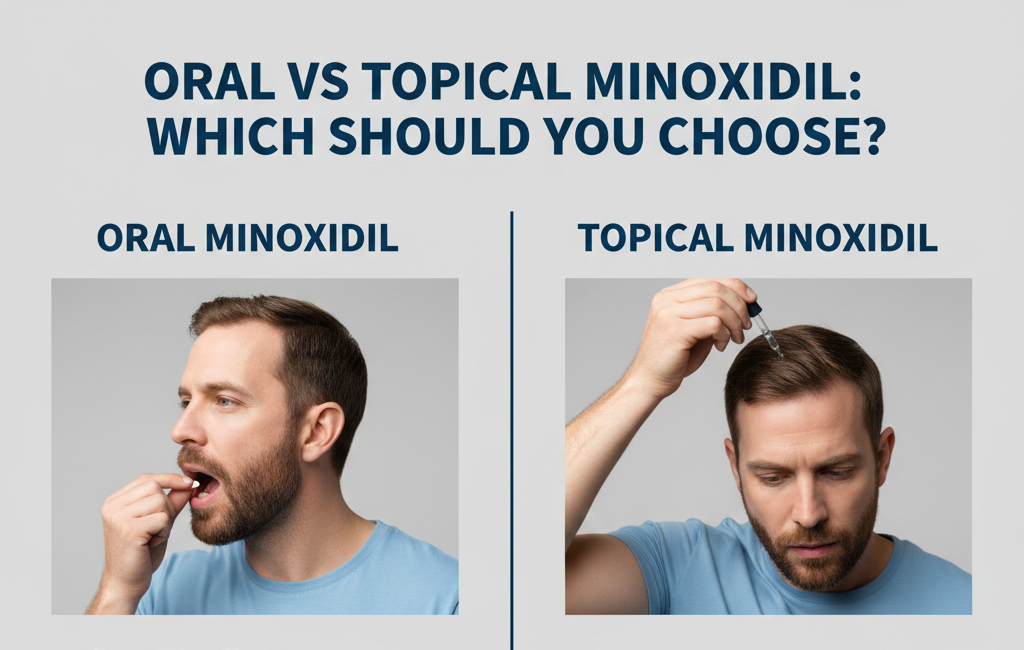
Millions struggle with androgenetic alopecia (pattern baldness), often facing frustration and self-consciousness. Fortunately, for decades, one treatment has stood the test of time: Minoxidil.
While you may be familiar with the over-the-counter liquid or foam, topical minoxidil, recent advances in dermatological science have renewed interest in a different form—oral minoxidil.
This shift has left many patients wondering: Is oral minoxidil better than topical? Which option is safest, most effective, and right for my unique hair loss pattern?
At Skin-Hair Clinic, we specialize in personalized hair restoration plans. We provide an in-depth look at the science behind both treatments to help you understand the nuances of the choice between minoxidil oral vs topical.
Understanding the minoxidil mechanism
Before comparing the two delivery methods, it is essential to understand the mechanism of action of minoxidil. Originally developed as an oral medication for high blood pressure, clinicians noted a remarkable side effect: Hair growth.
Today, it is known that minoxidil works as a potent vasodilator, meaning it widens blood vessels. This effect is thought to boost blood flow and nutrient supply to the hair follicles.
More importantly, minoxidil also appears to stimulate dormant hair follicles, pushing them into the growth phase (anagen) and prolonging the life cycle of existing hair. It is not an anti-androgen; rather, it is a growth stimulator.
Option 1: The tried-and-true topical minoxidil
Topical minoxidil is the traditional, over-the-counter solution (known widely by the brand name edapil M, mino foam y minoxidil MK). It is typically available in 2% and 5% concentrations.
Pros of topical minoxidil:
Targeted application: The main advantage is its local effect. Since the absorption into the bloodstream is minimal, the risk of systemic side effects is very low.
Safety profile: Due to its long history and low systemic absorption, it is considered highly safe for most users.
Accessibility: It is readily available without a prescription.
Cons of topical minoxidil:
Usage hassle: The application can be messy and inconvenient, particularly for individuals with long hair. It requires a dedicated application one to two times daily.
Local side effects: Common issues include scalp irritation, dryness, flaking, and contact dermatitis.
Reduced efficacy: In some individuals, the scalp lacks the necessary enzyme, sulfotransferase, to convert the minoxidil compound into its active form. This means that for some, topical minoxidil is not better than oral because it simply doesn’t work effectively.
Option 2: The regenerative oral minoxidil
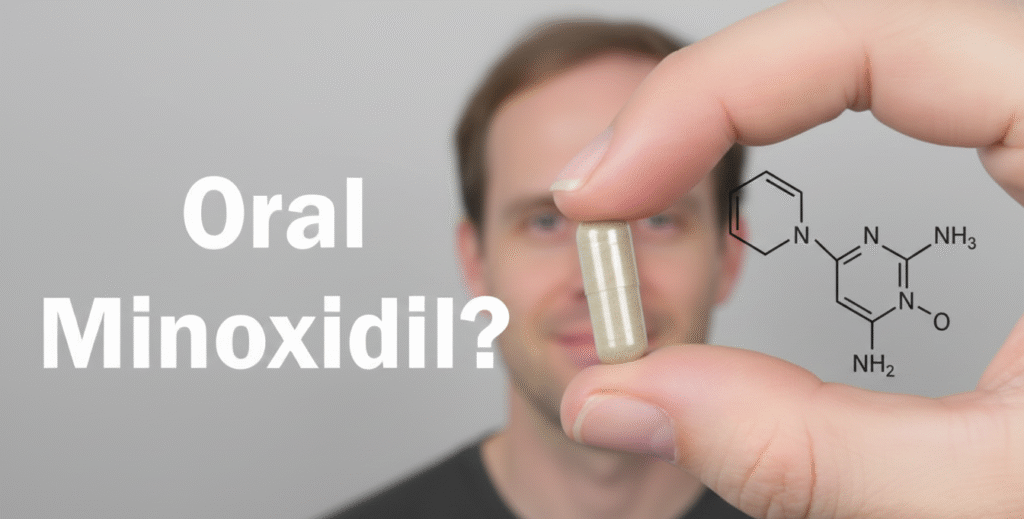
Does minoxidil come in pill form?
Yes, historically, but today’s hair loss treatment uses a low-dose, off-label application. Oral minoxidil for hair loss is typically prescribed in very small doses, ranging from 0.25 mg to 5 mg, much lower than the doses used for hypertension.
Pros of oral minoxidil:
Superior compliance: Taking a small pill once a day is far easier than topical application, increasing patient adherence to the treatment plan.
Systemic efficacy: Because it enters the bloodstream, it ensures that all hair follicles—including those on the scalp and possibly elsewhere—receive the active drug. This often leads to the conclusion that oral minoxidil works better than topical for many non-responders.
Ideal for women: Low-dose minoxidil pills for women (e.g., 0.25mg to 1.25mg) have shown remarkable success in treating female pattern hair loss with fewer cosmetic concerns (like irritation) than the topical form.
Cons and safety of oral minoxidil:
Systemic side effects: Since the drug is absorbed throughout the body, there is a risk of systemic side effects, though typically minor at low doses. These may include fluid retention (addressing the query does oral minoxidil cause weight gain—though actual weight gain is rare), temporary lower blood pressure, or ankle swelling.
Hypertrichosis (Excess hair growth): Unwanted hair growth on the face or body is the most common side effect.
Safety and prescription: Is oral minoxidil safe? Yes, when prescribed and monitored by a doctor. It requires a proper oral minoxidil prescription and regular check-ups to monitor blood pressure and rule out cardiac contraindications.
Which is better, oral or topical minoxidil?
Which is better, oral or topical, depends on individual needs; oral use is becoming more common. Many patients also ask, is oral minoxidil better than topical, as its popularity continues to rise.
Studies published in prominent dermatological journals have found that low-dose oral minoxidil (especially between oral minoxidil 2.5 vs 5 mg doses) can be highly effective, sometimes surpassing topical results, particularly in patients who failed to respond to the topical solution.
Why is oral minoxidil better than topical?
The oral formulation bypasses the need for the sulfotransferase enzyme in the scalp, guaranteeing that the drug is activated and reaches the follicle. This is often the reason why oral minoxidil is better than topical for certain individuals.
Also Read – How Long Do Hair Transplants Last?
Navigating combination and switching therapies
Switching minoxidil forms
If you are switching from topical to oral minoxidil, your doctor will guide you through the transition.
It’s a common strategy for individuals experiencing scalp irritation or lack of results from the topical solution. This switch is typically done gradually to maintain progress while the new regimen takes effect.
Can you take minoxidil orally and topically together?
While technically possible, combining oral minoxidil and topical forms is generally not recommended or necessary due to the increased risk of systemic side effects without a substantial increase in efficacy. This decision requires careful clinical consideration by your specialist.
Addressing other concerns
Regarding minoxidil and facial aging, there is no substantial evidence linking minoxidil usage (either topical or oral) directly to accelerated facial aging. Any temporary puffiness is typically related to fluid retention, rather than structural aging.

The ultimate guide to getting a beard transplant
The ultimate guide to getting a beard or facial hair

How Often Should You Do Red Light Therapy?
How often should you do red light therapy? Interest in
What Makes Advanced Hair Restoration Different from Traditional Methods?
What Makes Advanced Hair Restoration Different from Traditional Methods? Hair
Quick Enquiry
Your personalized treatment plan
The final decision between oral vs topical minoxidil is never a one-size-fits-all answer. It requires a detailed evaluation of your hair loss type, overall health profile, potential side effects, personal lifestyle preferences, and understanding is oral minoxidil better than topical based on your individual needs.
At Skin-Hair Clinic, we assess whether your hair loss warrants a systemic approach or a localized treatment. If you are questioning whether oral minoxidil is the right choice for your hair restoration journey, we encourage you to consult with our specialized team.
Schedule a personalized consultation with us today and determine the best minoxidil regimen to achieve your hair health goals.
Oral medications provide stronger results, while topical treatments have fewer side effects and target the affected area. Choose based on goals and medical advice to understand is oral minoxidil better than topical.
The best form depends on individual needs. Oral often promotes more hair growth. Consult a specialist for a safe choice.
Doctors rarely prescribe oral minoxidil due to higher risks, such as blood pressure or heart side effects. Topical is usually safer.
Oral minoxidil may yield better results due to stronger absorption. Consult a clinic for personalized advice and safe options.
Most people do well with topical minoxidil, but oral minoxidil can give stronger results if your doctor recommends it. If you’re wondering is oral minoxidil better than topical, choose the option that fits your needs and your doctor’s advice.
You can often use oral minoxidil for a long time if your doctor is monitoring you. How long you use it depends on how you respond and any side effects. Always follow your doctor’s advice.
The most trusted minoxidil is usually a 5% topical solution that’s FDA-approved. Use well-known brands and talk to a specialist for advice.
A 5% minoxidil solution usually works faster and gives more visible results, while 2% is milder for sensitive skin. Ask a professional which is best for you.
Wash hair every 2–3 days with minoxidil to keep the scalp clean without over-drying. Consistency is key for growth.
Yes, you can use minoxidil for as long as 20 years if it works well for you. Using it long-term helps keep your hair. Always follow your doctor’s advice. Many people also ask is oral minoxidil better than topical, but the right choice depends on medical guidance.
Minoxidil works well for many people. Most users see thicker hair and less shedding, especially if they start using it early and stick with it.
Yes, minoxidil can help with a receding hairline by making hair follicles more active and thickening your hair. You’ll get the best results if you use it regularly.