

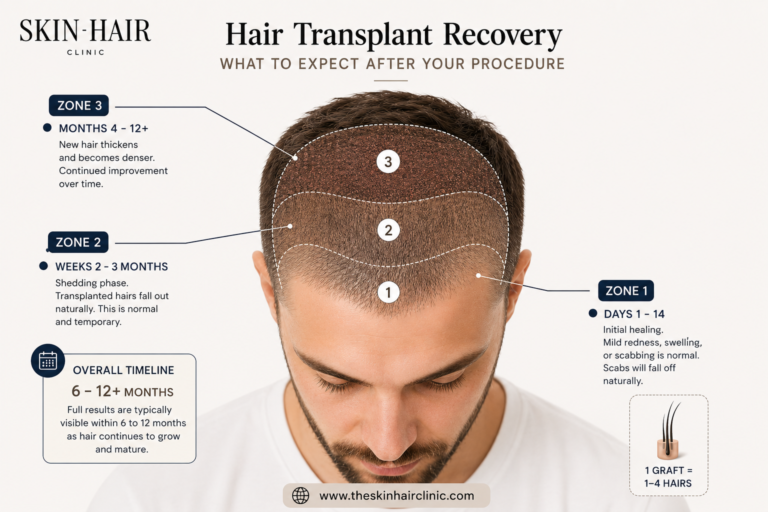
At a glance: Hair Transplant recovery
|
You’ve taken the first step and completed your hair transplant, and now you’re home with a new hairline mapped out in tiny grafts across your scalp. The excitement is real. So is the uncertainty. What happens next? What’s normal? What should alarm you?
Hair transplant recovery is as important as the procedure itself; arguably more so. The work done in the operating room is only half the equation. How you care for those grafts over the next several weeks determines how much of that transplanted hair actually survives and grows.
So let’s talk about how this works from the ground up.
How does a Hair Transplant work?
A hair transplant is a procedure that redistributes healthy, permanent hair follicles from one area of the scalp to areas affected by thinning or hair loss.
The most commonly used technique today is FUE hair transplant (Follicular Unit Extraction), where individual hair follicles are taken from the donor area, usually the back or sides of the scalp, and transplanted into areas affected by hair loss.
The follicles are carefully implanted into areas of thinning or hair loss to create a natural-looking result. Over the following weeks, they establish a blood supply, heal within the scalp, and gradually begin producing new hair.
At Skin and Hair in Colombia, every procedure is supported by personalized aftercare and follow-up to promote healthy healing, strong graft survival, and natural-looking results.
The Hair Transplant recovery timeline: Day by day
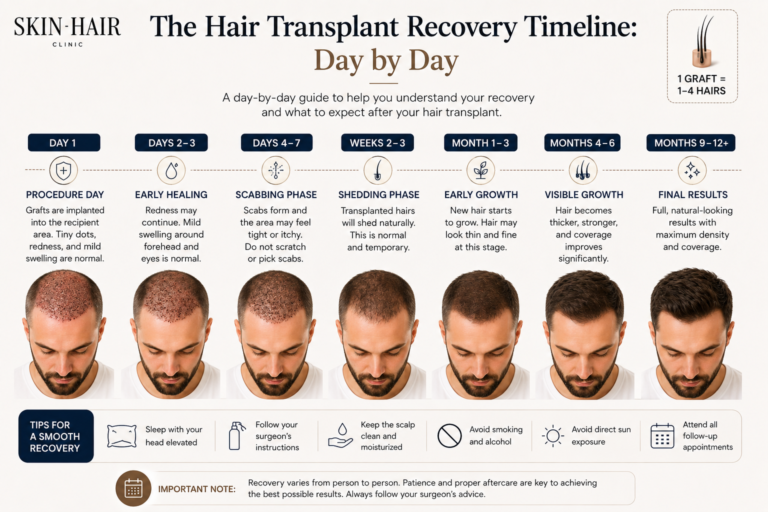
Every patient heals at a slightly different pace based on genetics, lifestyle, and skin type. However, the typical hair transplant timeline follows a highly predictable pattern.
Let’s break down the hair transplant stages so you know what is happening under the surface.
Phase 1: The first 72 hours (Setting the foundation)
Your recovery starts as soon as the procedure is complete. During the first few days, mild swelling, tenderness, and tightness are common, along with small scabs forming around the grafts as the scalp heals.
Hair transplant day 3 is when patients report the most discomfort during hair transplant recovery. The scalp can feel itchy and swollen. Avoid scratching or rubbing the scalp, and sleep with your head elevated to help reduce swelling and protect the newly transplanted grafts.
At this stage, after hair transplant care is simple: avoid touching the grafts, follow your clinic’s washing instructions carefully, stay out of direct sunlight, and avoid strenuous activity.
Phase 2: Week 1 (Scabs & early healing)
Between days 4 and 7, healing continues and the small scabs around the grafts start to soften. Your clinic may recommend gentle washing or saline sprays to keep the scalp clean and support the hair transplant healing process.
By the end of the first week, many patients notice the scabs starting to fall away naturally. Avoid picking or scratching them, as this can disturb newly implanted follicles.
The donor area usually heals more quickly than the transplant site. In most cases, the tiny extraction points are barely visible by day seven, and any discomfort has significantly improved.
Phase 3: Week 2-4 (Temporary shedding)
This is the stage that catches many patients off guard during hair transplant recovery. Between weeks 2 and 4, it’s common for the transplanted hairs to shed, a temporary process known as shock loss.
Although the hairs fall out, the follicles remain in place beneath the scalp and continue healing. This is a normal part of the hair transplant recovery process and does not mean the transplant has failed.
Continue following your aftercare instructions, wash the scalp gently, avoid activities that cause excessive sweating, and protect the area from direct sun exposure.
Phase 4: Month 1-3 (Dormancy and early sprouts)
Between weeks four and twelve, the scalp enters a quiet phase. Very little visible growth occurs. For many patients, this is the most challenging part of the recovery process because the transplanted hairs have shed, but new growth is not yet visible.
While visible growth may be limited, new hairs often begin to appear between months 2 and 3. These early hairs are typically finer, softer, and lighter at first.
Post hair transplant care at this stage shifts toward scalp health: gentle shampoos, avoiding harsh chemical treatments, and protecting the scalp from UV damage.
Phase 5: Month 4-8 (Visible progress)
By around month four, new growth becomes more noticeable. The hair starts to thicken, and the hairline becomes more defined.
Hair transplant aftercare now extends to protecting your investment long-term: using dermatologist-recommended shampoos, avoiding excessive heat styling, and attending follow-up appointments can help support the best possible result.
Phase 6: Month 9-18 (Final results)
Many patients ask, how long does a hair transplant take to heal completely? Although the scalp usually heals within a few weeks, the final cosmetic result takes much longer to develop.
Between months 9 and 18, the transplanted hair continues to mature and gain density. While many patients see substantial growth by months 6-12, further thickening and refinement can continue well beyond the first year.
Patience is important. Hair growth happens gradually, and the full results of a hair transplant are only revealed once the follicles have completed their natural growth cycle.
Also Read – How many hair grafts do I need for a natural-looking hairline?
Hair Transplant maintenance: Protecting your results long-term
Proper after hair transplant care can significantly influence healing and long-term results:
- Follow your dermatologist’s recommendations: Continue any prescribed medications or treatments to help protect existing hair and support long-term results.
- Use gentle hair products: Choose mild shampoos and conditioners that support scalp health without irritating the scalp.
- Protect your scalp from the sun: Newly transplanted follicles are sensitive to UV exposure, especially during the early healing period.
- Maintain a healthy lifestyle: A balanced diet, good sleep, stress management, and avoiding smoking can support healthy hair growth.
- Limit heat and chemical treatments: Frequent heat styling, bleaching, and harsh chemical products may weaken the hair over time.
- Attend follow-up appointments: Regular reviews allow your specialist to monitor progress, assess graft survival, and address any concerns before they affect your results.
- Monitor ongoing hair loss: A hair transplant restores lost hair but does not prevent future hair thinning in untreated areas.
Factors that influence how long does Hair Transplant recovery take
When looking into how long is the recovery for hair transplant procedures, remember that individual biology plays a big role.
- Type of procedure: The FUE recovery timeline is typically faster than older transplant techniques, with less discomfort and quicker healing.
- Size of the procedure: Larger transplants may involve more swelling and scabbing, which can prolong recovery slightly.
- Individual healing factors: Recovery can vary based on age, overall health, and lifestyle habits such as smoking.
- Hair type: Hair texture can affect both the procedure and recovery. For example, african american hair transplant recovery time may vary due to the unique structure of curly hair follicles.
- Aftercare and follow-up: Following aftercare instructions, protecting the scalp, and attending follow-up appointments can help support a smoother hair transplant recovery.
Also Read – How Long Do Hair Transplants Last?


How Long Does Botox Last? A Complete Guide to Botox Results
How Long Does Botox Last? A Complete Guide to Botox
Colombia vs Turkey Hair Transplant: Which Country Offers Better Results in 2026?
Colombia vs Turkey Hair Transplant: Which Country Offers Better Results
Hair Transplant Cost Colombia: Complete 2026 Pricing Guide
Hair Transplant Cost Colombia: Complete 2026 Pricing Guide Hair loss
Quick Enquiry
Why choose a Skin and Hair Clinic for your Hair Restoration?
Successful hair transplant results begin with the right clinical team, long before a single graft is placed.
Skin and Hair is one of Medellin, Colombia’s leading dermatology and hair restoration clinics, offering personalized treatment plans tailored to each patient’s hair loss pattern, donor area, hair texture, and goals. Their focus is on creating natural-looking results rather than a one-size-fits-all approach.
From the initial consultation through follow-up, every stage of the hair transplant journey is closely monitored to support healing, hair transplant recovery, and graft growth. The team combines surgical expertise with personalized aftercare for natural-looking results.
For patients in Medellin, Colombia, Skin and Hair offers world-class hair restoration backed by the convenience of ongoing, accessible follow-up care throughout the hair transplant recovery process.
Most visible healing occurs within 10–14 days as scabs and redness fade. New hair growth develops gradually, with final results typically seen after 12–18 months.
The main types of hair transplants include FUE, FUT, and DHI. FUE is the most commonly performed method due to its minimal scarring and faster recovery.
Most patients return to desk-based work within 5–7 days. Strenuous exercise and physically demanding work should generally be avoided for several weeks.
Hair transplant right after the procedure, expect tenderness, mild swelling, and small scabs forming around each graft. Swelling around the forehead is common in the first three days. Sleep with your head propped up, avoid touching the grafts, and follow your clinic’s washing instructions carefully. This phase lasts about one week.
The donor area typically heals faster than the recipient zone. With FUE, the tiny extraction points close within five to seven days. There is no linear scar to contend with, and most patients find the back of the scalp is barely noticeable within two weeks.
Following your surgeon’s aftercare instructions, avoiding smoking, protecting the scalp from sun exposure, eating a nutritious diet, staying hydrated, and avoiding strenuous activities during the early healing phase can all support a smoother recovery.
Transplanted hair follicles are generally resistant to the hormone responsible for pattern hair loss, making the results long-lasting. However, natural hair outside the transplanted area may continue to thin over time, which is why some patients choose additional treatments or procedures in the future.
Most patients experience only mild discomfort rather than significant pain. Tenderness, tightness, and minor swelling are common during the first few days, but these symptoms are usually well controlled with prescribed medication and proper aftercare.
Yes. Temporary shedding of the transplanted hairs, known as “shock loss”, is a normal part of the recovery process. This usually occurs within the first few weeks and is followed by new hair growth from the transplanted follicles.
Most patients notice the first signs of new hair growth between three and four months after the procedure. Hair density and thickness continue to improve over the following months.