
Is a hair transplant painful? What to expect
How local anesthesia works, what you feel during the procedure and which discomfort is normal in the days of recovery.

Written and reviewed by Dr. Lina María Muñoz
Dermatologist · · 7 min read
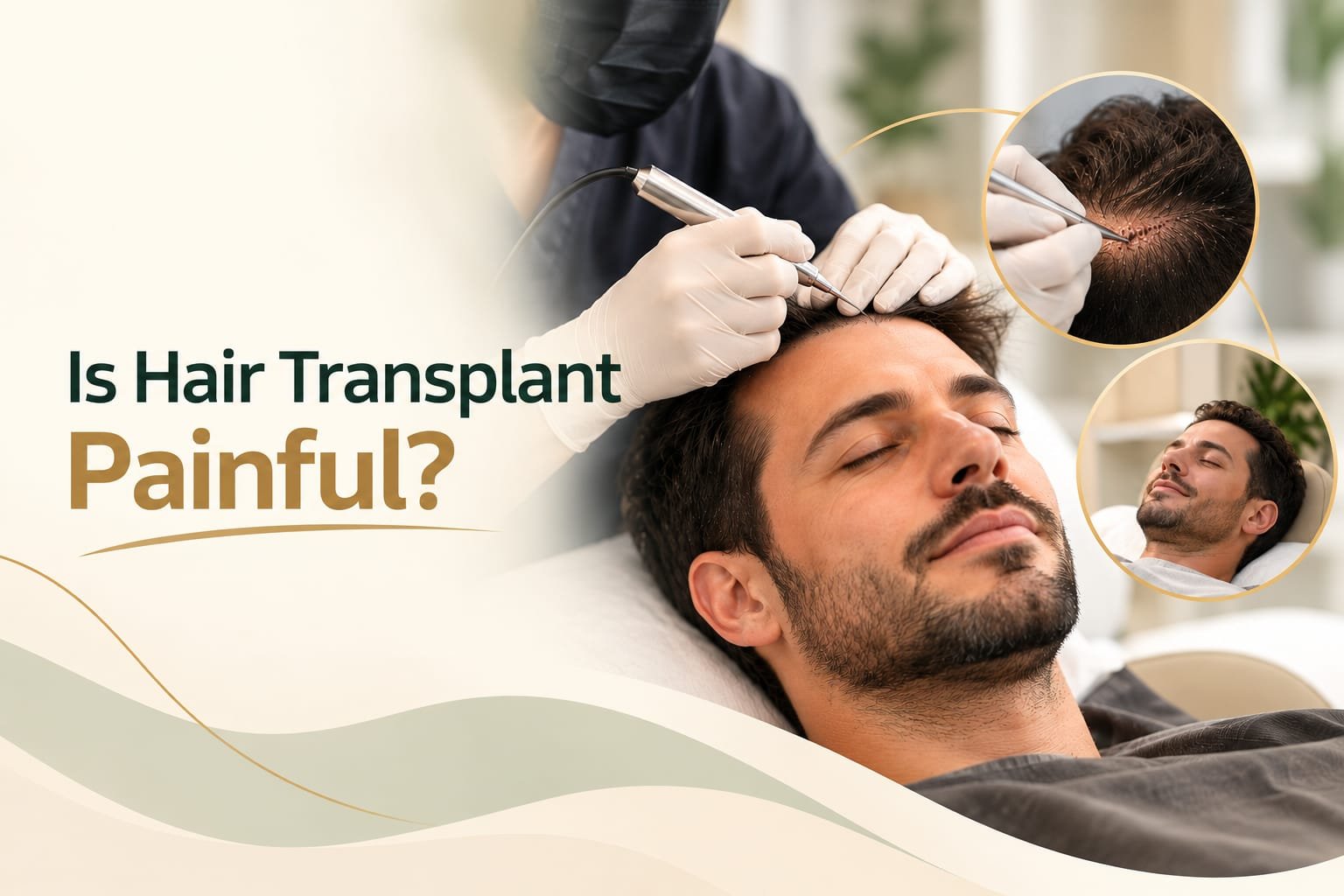
You’ve finally decided to do something about thinning hair, the consultation went well, and then one thought keeps coming back at 2 a.m.: Is hair transplant painful? You’re far from alone.
For most people, the fear of hair transplant pain is bigger than the sensation itself, and it is a common concern for people considering hair restoration at Skin & Hair Clinic in El Poblado, Medellín.
This guide helps you understand the pain after hair transplant, right from numbing injections to the second week of healing. So, you know what’s normal, if you’ve been asking yourself, ‘Does hair transplant hurt?’ Here’s what to expect.
Is a hair transplant painful during the procedure?
For most patients, the answer is no or only minimally.
Hair transplantation is generally performed using local anesthesia. The medication temporarily blocks pain signals from the treatment area, allowing you to remain awake while the scalp is numb. The NHS confirms that hair transplants are usually carried out under local anesthesia, with patients awake but unable to feel pain from the procedure.
You may still notice sensations such as:
- A brief pinch or sting when the anesthetic is injected
- Pressure or movement on the scalp
- Vibration from instruments used during follicle extraction
- Touching or pressure around the recipient area
- Mild sensitivity as the anesthesia begins to wear off
This is an important distinction: Little or no pain does not necessarily mean you will feel nothing. Being aware of pressure or movement during treatment is quite different from experiencing sharp pain.
What does hair transplant pain feel like?
People often imagine that a transplant will involve continuous pain because hundreds or thousands of grafts may be handled during treatment. In reality, the sensations are usually more manageable than the procedure may sound.
- Before you start: Nerves are normal
At your consultation, ask the doctor to walk you through each step of the hair transplant procedure so nothing feels like a surprise. Before the first graft is placed, your doctor numbs the donor area and the area being treated. Local anesthesia blocks pain signals in a small, targeted zone, so there’s no need for general anesthesia.
Because you’re awake, you can take breaks and tell the team if something feels off.
- The numbing phase: Does hair transplant hurt here?
This is the part patients remember. The anaesthetic is administered via small injections, and most people report a brief pinch or sting before the area goes numb. It passes within moments. If you feel anything sharp later in the session, tell the team right away.
- Pain during hair transplant: Pressure, not sharp pain
Once the scalp is numb, most patients feel pressure or light tugging. Depending on the number of grafts, the session can take several hours, so sitting still is often more tiring than painful.
Is hair transplant surgery painful after the anesthesia wears off?
This is where the experience changes slightly.
Once the hair transplant anesthesia begins to wear off, you may become more aware of the treated areas. This does not necessarily mean you will experience significant pain. More commonly, patients may notice tenderness, tightness, mild aching, or sensitivity.
A tight, achy, and swollen scalp for several days can be a normal side effect after a hair transplant.
Hair transplant recovery: What may feel normal
| Recovery stage | Possible sensation |
|---|---|
| First few hours | Numbness as anesthesia remains active |
| First 1–2 days | Mild soreness, tenderness, or tightness |
| First few days | Swelling or scalp sensitivity |
| Around one week | Discomfort generally becomes less noticeable |
| Following weeks | Occasional altered sensitivity may occur |
Your individual hair transplant recovery may not follow the same timeline. The number of grafts, treatment area, technique, and your body’s healing response can all make a difference.
Pain after hair transplant: A day-by-day recovery map
Hair transplant recovery pain is usually mild and short-lived, though the exact experience varies. Use this as a general guide:
| Timeline | What to expect |
|---|---|
| Days 1 to 3 | You will feel tenderness, tightness, and some swelling, which may appear on the forehead or around the eyes. Try to sleep with your head elevated. |
| Days 4 to 10 | Scabs form, and itching is common. Soreness fades, don’t urge to pick or scratch. |
| Weeks 2 to 4 | Most discomforts settle. Get back to your usual haircut and grooming routine once your clinic approves. |
| Months 3 to 4 | New growth may become noticeable after several months, while the outcome can take considerably longer to develop. |
Most patients return to normal activities within a few days, but hair transplant recovery continues well beyond that as new hair grows. Dr Lina provides each patient with specific recommendations, restrictions, and care instructions for the healing period.
When to call your doctor:
- Pain that gets worse instead of easing
- Fever, pus, or spreading redness
- Heavy or ongoing bleeding
If hair transplant recovery pain suddenly worsens instead of fading, contact the clinic rather than waiting it out.
What causes hair transplant discomfort?
Knowing what can cause discomfort can help you feel more prepared for the recovery process.
- Anesthetic injections – The initial injections can cause brief stinging or pinching.
- Multiple extraction sites – FUE involves extracting individual follicles so that the donor area may feel tender afterwards.
- Recipient-site irritation – The scalp has multiple tiny treatment sites that can remain sensitive during early healing.
- Swelling and tightness – Temporary swelling can create a feeling of pressure across the scalp.
- Individual sensitivity – People naturally experience procedures and pain differently.
- Prolonged positioning – Because a transplant can take several hours, staying in one position may cause some general physical discomfort even when the scalp itself is well anesthetized.
Does hair transplant pain depend on the technique?
Not necessarily. FUE and DHI differ mainly in how the grafts are handled and implanted, rather than one being universally painless and the other painful.
| FUE | DHI | |
|---|---|---|
| Anesthesia | Local anesthesia | Local anesthesia |
| Follicle extraction | Individual grafts | Individual grafts |
| Implantation | Recipient channels are prepared before placement | Grafts are implanted using a Choi implant pen |
| During treatment | Pressure or movement may be felt | Pressure or movement may be felt |
| After treatment | Temporary tenderness is possible | Temporary tenderness is possible |
Skin & Hair Clinic notes that the choice between FUE and DHI is usually based on factors such as the pattern of hair loss, donor supply, treatment area, desired density, and the clinician’s assessment, not simply which technique is expected to hurt less
Hair transplant aftercare that keeps you comfortable
Good hair transplant aftercare is one of the most useful tools for keeping soreness low, and it protects the grafts, too:
- Sleep with your head elevated as advised by your doctor, particularly during the early recovery period
- Avoid pressure on the transplanted area.
- Don’t scratch, pick, or rub scabs.
- Take pain relief only as your doctor prescribes or advises.
Following instructions closely keeps hair transplant discomfort to a minimum.
Personalized hair transplant care in Medellín, led by a Dermatologist
At Skin & Hair Clinic, your hair transplant procedure is tailored to your hair type, goals, and comfort. Dr. Lina María Muñoz is an MD dermatologist trained in Colombia, Panama, and Spain, and a member of the Colombian Association of Dermatology (Asocolderma).
- Dermatologist-led planning and guidance
- FUE, Sapphire FUE, and DHI options
- Support from consultation through aftercare
- Care for both men and women, including beard and eyebrow transplants
Comfortable hair restoration starts with the right plan
A hair transplant should not be approached with the expectation that you will feel absolutely nothing. Instead, the goal is to understand what sensations are normal, know how discomfort will be managed, and have clear aftercare guidance throughout recovery.
Concerned about pain or unsure whether FUE or DHI is right for you? Schedule a consultation with Skin & Hair Clinic to discuss your hair restoration options with a dermatologist-led team.
Related treatment
Hair transplant
It starts with an assessment with the doctor, who tells you which treatment makes sense for you.
FAQ's on hair transplant Colombia
Is a hair transplant painful?
Most patients do not experience significant pain during the procedure because the scalp is numbed with local anesthesia. Brief discomfort from the injections is possible.
Does hair transplant hurt after the procedure?
Mild soreness, tightness, tenderness, or swelling can occur after the anesthesia wears off. These symptoms generally improve as the scalp heals.
How long does the pain last?
The most noticeable discomfort is usually during the early recovery period. Your individual recovery can vary depending on the treatment and your healing response.
Is FUE hair transplant painful?
FUE is performed under local anesthesia, so significant pain during extraction is not usually expected. Temporary tenderness afterward is possible.
Is DHI less painful than FUE?
Neither technique can be described as universally less painful. Both use local anesthesia, and comfort can vary between patients.
What helps to reduce pain after hair transplant?
Following your clinician’s aftercare instructions, protecting the grafts, and using only recommended medication can help make recovery more comfortable.
Start with an assessment
Message us on WhatsApp and we’ll book you in with Dr. Lina María Muñoz.
Message us on WhatsApp+57 300 272 1343